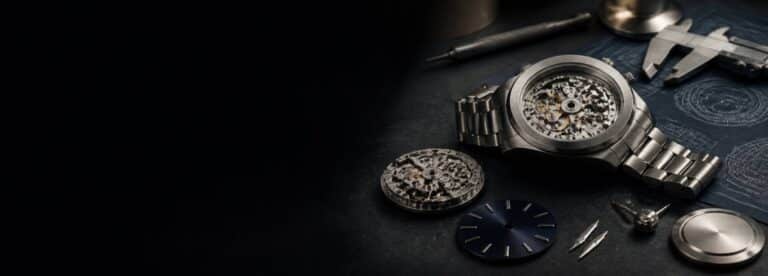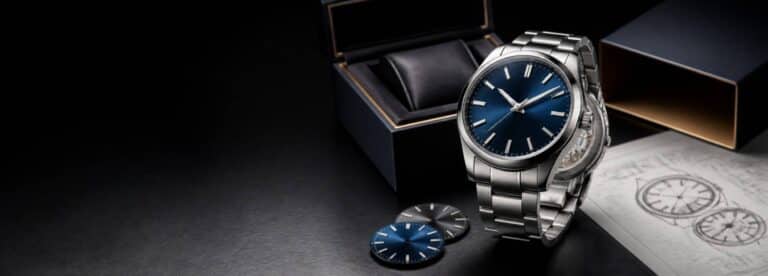
Launching a watch collection requires a balance between product ambition and inventory risk. For retailers, emerging brands, distributors, and organizations entering the premium watch market, a lower minimum order quantity can make it easier to test demand without committing to an oversized first production run.
However, low MOQ private label watches are not a one-size-fits-all offer. The achievable order quantity depends on the watch platform, mechanical movement, branding scope, packaging, material availability, and level of customization required.
For selected existing watch platforms, a private label mechanical watch project may begin at a lower production quantity—potentially around 50 pieces in some cases. The final MOQ must always be confirmed based on the actual project specifications.
This guide explains what low MOQ means in private label watch manufacturing, what affects the minimum order quantity, and how retailers can plan a commercially practical first watch collection.
Important: ZELX works with brands, retailers, distributors, and organizations planning production orders. Our private label service is not intended for one-off personal watch customization.
What Does Low MOQ Mean in Private Label Watch Manufacturing?
MOQ stands for minimum order quantity. In watch manufacturing, it is the lowest quantity a supplier can reasonably produce for a specific configuration while maintaining material sourcing, production efficiency, assembly control, and quality standards.
A low MOQ does not mean every watch design can be produced in very small quantities. It usually means that a brand can start from an existing, manufacturable watch platform and apply selected branding or visual customization without developing a completely new product architecture.
For a private label mechanical watch project, the starting platform may already include:
- A proven case construction
- An available automatic or mechanical movement
- Compatible dial and hand configurations
- Existing strap or bracelet options
- Established assembly and quality-control processes
This approach helps reduce development risk compared with creating a new case, special movement layout, or proprietary component set from scratch.
If you are new to this production model, read [What Is Private Label Watch Manufacturing?] to understand how private label projects differ from fully custom watch development.
Can You Launch a Private Label Mechanical Watch Collection with 50 Pieces?
In some situations, yes. A quantity around 50 pieces may be possible for selected existing watch platforms with manageable branding requirements. But it should be treated as a project-specific starting point—not as a universal guarantee.
A lower-quantity project is generally more feasible when you choose:
- An established case and movement combination
- Existing dial layouts or compatible dial construction
- Standard strap, bracelet, or buckle options
- Limited color variations
- Straightforward dial logo application
- Existing packaging formats with brand inserts or printed elements
- Components that are currently available for production
For example, a retailer may select an existing automatic watch platform, choose one dial color, add a logo, engrave a caseback, and use branded packaging. This type of focused configuration is typically more suitable for a lower-MOQ discussion than a project requiring a new case shape, exclusive bracelet, special complication, and fully custom packaging structure.
The right question is not simply, “Can I order 50 watches?” It is:
“Which watch configuration can support my target quantity while still delivering the quality and brand identity my customers expect?”
What Determines the MOQ for Private Label Watches?
The final MOQ is determined by how closely your project aligns with an existing production platform. The more new development, sourcing complexity, or special manufacturing work involved, the more likely the order quantity requirement will increase.
Watch Platform and Case Configuration
Using an established case platform is one of the most effective ways to keep a project manageable. Existing case shapes, dimensions, caseback structures, bezel options, and water-resistance constructions have already been engineered for production.
A completely new case design often requires technical development, new molds or tooling, sample validation, and additional quality checks. Those requirements can increase both MOQ and project cost.
For a first collection, many retailers benefit from choosing a proven case platform and differentiating it through dial design, finishing direction, color, branded details, and packaging.
Mechanical Movement Availability
The movement is a critical component of a mechanical watch, and its availability can directly affect production planning. Movement choice influences case thickness, dial configuration, hand height, date-window placement, and the overall structure of the watch.
When a selected automatic movement is already compatible with the chosen platform and available through the production supply chain, lower-volume planning is often more practical. A special movement, an unusual complication, or a movement requiring a redesigned case and dial may require a different MOQ discussion.
Before confirming your design, ask which movement options are suitable for your selected watch platform, target price position, and estimated order quantity.
Dial, Logo, and Branding Requirements
The dial is one of the strongest tools for making a private label watch feel proprietary to your brand. At the same time, the level of dial customization can affect MOQ.
More manageable private label options may include:
- Printed logos or wordmarks
- Selected dial colors and standard finish options
- Existing index layouts
- Standard hand sets
- Caseback engraving
- Customized crowns, depending on the platform
- Branded straps, buckles, or packaging components
More complex requirements may require a higher quantity, including:
- Newly developed dial construction
- Custom-applied indexes with special shapes
- Multi-layer dials or highly specialized textures
- Non-standard luminous treatments
- Exclusive hand tooling
- Custom metal components
- Unusual complications or display layouts
The best approach is to prioritize the details that customers will recognize most clearly, rather than attempting to customize every component in the first production run.
Straps, Bracelets, and Packaging
Straps, bracelets, clasps, and packaging can strongly influence the perceived value of a mechanical watch. They can also affect sourcing requirements and MOQ.
A standard leather strap or existing stainless-steel bracelet option may be easier to integrate into a lower-volume project. In contrast, an exclusive bracelet design, a custom clasp mold, or specialized strap hardware can add development and purchasing complexity.
The same principle applies to packaging. A premium watch box with a branded sleeve, printed card, warranty materials, and logo application may suit a lower-MOQ strategy better than a completely new box structure requiring custom tooling.
Your first production order should deliver a complete branded experience, but each element should have a clear role in the product strategy.
New Tooling and Custom Components
New tooling is one of the main reasons an MOQ can increase. It may be needed for a new case, a special bezel, a custom crown, proprietary hands, a metal logo badge, a bracelet link, or a new packaging structure.
Tooling can be appropriate for an established brand with a highly differentiated design strategy. But it is usually not the most efficient starting point for a retailer testing a new watch category or a new brand launching its first collection.
If a distinctive product is essential to your brand story, discuss the project in stages. You may begin with a private label platform to validate the market, then develop a more customized OEM collection after you have customer feedback and sales data.
How Retailers Can Keep Their First Watch MOQ Manageable
A lower MOQ is easier to achieve when the initial collection is focused. The goal is not to offer every possible option at launch. The goal is to create a product that is clear, credible, and commercially testable.
Consider the following strategy:
- Start with one core watch platform
- Choose one primary case size and one movement configuration
- Limit the collection to one or two dial colors
- Use one strap or bracelet direction for the first run
- Keep logo application and dial details refined but practical
- Use premium existing packaging with your brand elements
- Plan for a reorder rather than overstocking multiple unproven variations
For example, instead of launching three unrelated mechanical watch models in several colors, a retailer could launch a single automatic watch platform in black and deep blue dial versions, with a branded leather strap and matching presentation box.
This creates a cohesive product story while reducing the number of separate components and stock-keeping units that must be planned, approved, and sold.
A Smart First-Order Strategy for New Watch Brands
The first order is not only a production purchase. It is a market test, a content asset, and the foundation of your product system.
Before placing an order, estimate how you will sell the watches. Consider your expected monthly sales, target retail price, wholesale margins, marketing budget, storage capacity, fulfillment process, and customer service plan.
A practical first-order strategy usually includes:
- A defined target customer rather than a broad “luxury buyer” audience
- A focused product story and price position
- A small number of easy-to-understand variants
- A launch plan for product photography, video, email marketing, retail displays, or social media
- A clear decision on whether the watches will be sold direct-to-consumer, through stores, or via distribution partners
- A reorder plan if the first production run performs well
Do not base the project only on the lowest possible order quantity. The best MOQ is the one that allows you to maintain product quality, deliver a coherent brand experience, and carry a realistic level of inventory.
Low MOQ Private Label vs Custom OEM
Private label manufacturing is often the more practical route for lower-quantity launches because it begins with existing, proven watch platforms. Custom OEM is typically better suited to brands that need an exclusive structure, proprietary case, unique component design, or deeper engineering control.
| Consideration | Low MOQ Private Label | Custom OEM |
|---|---|---|
| Starting point | Existing manufacturable watch platform | New or substantially redesigned product |
| Development scope | Selected branding and visual customization | Broad structural, technical, and component customization |
| Tooling needs | Often limited, depending on requirements | More likely to require new tooling |
| MOQ suitability | More suitable for controlled first runs | Often better suited to larger development programs |
| Time to launch | Usually more efficient | Usually longer due to design and validation |
| Ideal buyer | Retailers, new brands, distributors, and market-testing projects | Brands requiring a highly differentiated product architecture |
If you are deciding between production routes, read our guide to Private Label, OEM, and ODM Watch Manufacturing to compare the three models in more detail.
What to Prepare Before Requesting a Quote
A detailed inquiry helps a manufacturer evaluate whether your target quantity is feasible and recommend the right production route.
Before requesting a private label watch quote, prepare:
- Your company name, website, and target market
- Estimated order quantity
- Target retail price or target product budget
- Preferred style, such as dress, sport, dive, skeleton, or classic automatic
- Preferred case size, material, and color direction
- Mechanical or automatic movement preference
- Dial logo files and basic branding guidelines
- Strap or bracelet preference
- Packaging requirements
- Target sales region and desired delivery date
- Reference images that communicate style, not designs to be copied
You do not need final technical drawings to begin a private label discussion. A clear business objective, visual direction, expected quantity, and target timeline are often enough to start evaluating suitable watch platforms.
For additional guidance, visit our Watch Manufacturing FAQ or speak with our team about your requirements.
Start Your Low MOQ Private Label Watch Project
Low MOQ private label mechanical watches can give retailers and emerging brands a more controlled way to enter the premium watch category. The key is to start with a realistic configuration, focus on the details that define your brand, and align the initial order quantity with your sales plan.
For selected watch platforms, lower production quantities may be available. The final MOQ will depend on the case and movement configuration, branding details, packaging, component availability, and customization level.
ZELX works with qualified B2B clients worldwide to develop premium private label automatic and mechanical watch collections. Share your target market, preferred style, estimated quantity, branding requirements, and launch schedule, and we can help assess the most suitable path forward.